Tumour-informed approach
The panel is designed directly from the variant profile of the patient's tumour, giving higher sensitivity for unique biomarkers than tumour-naive panels.
Twist Bioscience
MRD Express brings fast, highly sensitive tumour-informed testing for minimal residual disease (MRD). Personalised panels are manufactured and shipped within 24 hours of design submission, the fastest on the market.

Coming soon
Minimal residual disease (MRD) is the small number of cancer cells that remain in the body after successful therapy. Detectable MRD is a risk factor for relapse, so early detection allows earlier therapeutic intervention.
Twist MRD Express is a personalised panel based on the characteristics of the individual patient's tumour. From the variant profile of the primary tumour, obtained for example by WGS, WES or a targeted panel, 50–500 unique variants are selected, and Twist uses them to prepare a custom panel. In repeated testing of plasma cfDNA after treatment, the panel makes it possible to monitor tumour biomarkers in the blood and to detect the return of circulating tumour DNA (ctDNA) significantly earlier than standard imaging methods.
The panel is designed directly from the variant profile of the patient's tumour, giving higher sensitivity for unique biomarkers than tumour-naive panels.
You choose the panel size to suit your needs, from a focused 50 to a broad 500 variants per patient. Suitable for clinical research and large studies.
Just 24 hours from submission of the personalised design to shipment of the panel.
Full compatibility with the Twist library preparation system and hybridisation reagents.
The tumour-informed approach requires a one-off variant profile of the primary tumour. After that, all that is needed is repeated testing of plasma cfDNA at set intervals.
Before therapy, a complete variant profile of the patient's primary tumour is generated using WGS, WES or a targeted panel.
From the variant profile, you select 50–500 unique variants characteristic of the tumour.
Twist manufactures a custom MRD Express panel from the BED file. The silicon platform enables rapid personalisation. Shipped within 24 hours.
After therapy, you test the patient's plasma cfDNA at set intervals with the personalised panel (compatible with the Twist cfDNA TrueAmp Kit).
The reappearance of ctDNA biomarkers in the blood indicates MRD, allowing intervention before clinical signs of relapse.
Twist offers five ready-made 200-probe MRD panels for the most common tumour types. They are available immediately and optimised for the typical somatic variants of each cancer type.
Pre-designed 200-probe panel for breast cancer, covering typical somatic variants (BRCA, PIK3CA, TP53, ESR1...).
Panel for lung carcinoma: EGFR, KRAS, ALK, ROS1, BRAF, MET, RET and other key driver variants.
Colorectal carcinoma: KRAS, NRAS, BRAF, APC, TP53, PIK3CA and MSI markers.
Melanoma: BRAF V600E/K, NRAS, NF1, TP53, CDKN2A driver variants.
Renal carcinoma: VHL, PBRM1, SETD2, BAP1 and MTOR pathway variants.
MRD panel data for 5 cancer types with UMI consensus and 20,000× downsampling.
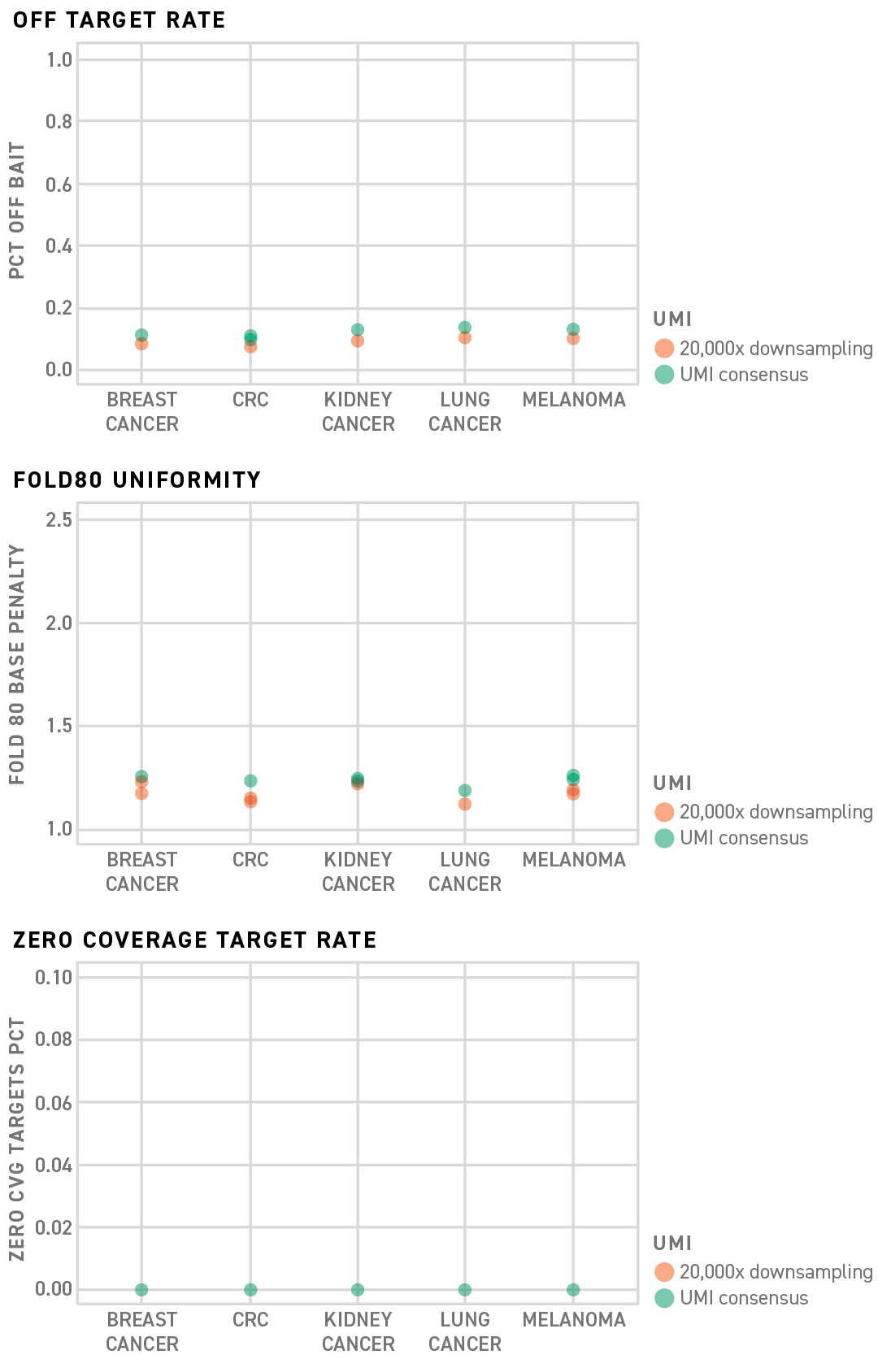
Off-target rate (~10%), Fold 80 uniformity (~1.2) and zero-coverage target rate (0%): stable performance on the breast, colorectal, kidney, lung and melanoma panels. Both with UMI consensus and with 20,000× downsampling.
An MRD readout for clinical studies: personalised panels suitable for large multicentre studies.
Real-time monitoring of therapy response based on the decline of ctDNA biomarkers. Helps time the next step of therapy.
Validation of new MRD biomarkers and comparative studies of tumour-informed vs. tumour-naive approaches.
A bridge between primary tumour sequencing and clinical monitoring, taking findings from the laboratory into patient care.
We will be happy to help with panel design, protocol validation and integration into your laboratory. Get in touch.