1-channel P20, P300 and P1000
Three models with ranges of 1–20 µl, 20–300 µl and 100–1,000 µl. For master mixes, dilutions and routine pipetting from tubes.
Compact · Affordable · NGS-ready
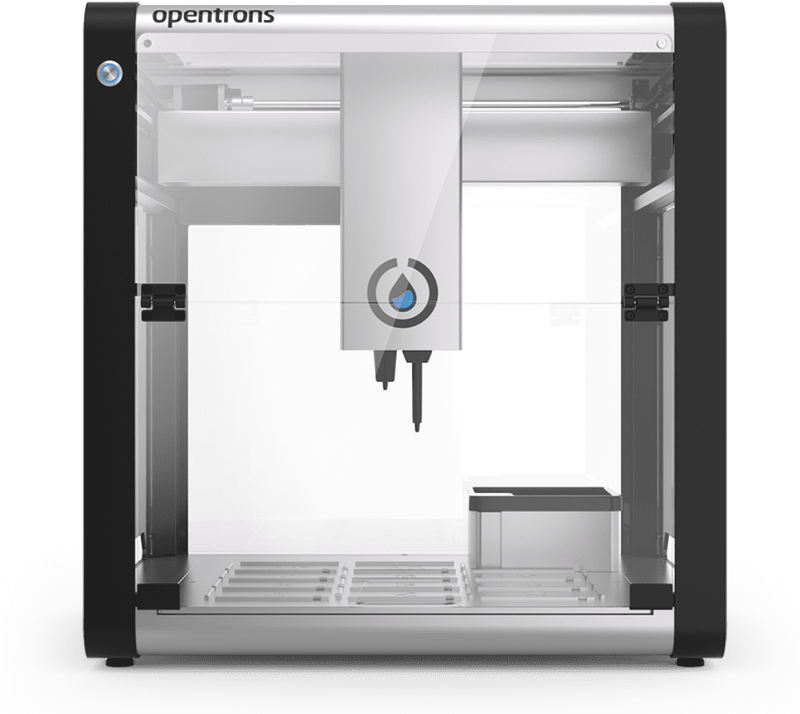
OT-2 is the first Opentrons robot. It fits on half a lab bench (63 × 57 × 66 cm, 48 kg) and offers 11 deck slots and single- and 8-channel P20, P300 and P1000 pipettes. It is compact and can be used for extraction, PCR setup and NGS libraries.
OT-2 is the first widely adopted Opentrons robot, on the market since 2018. Its compact format, simple operation and affordable price have made it a common choice for academic institutions, teaching, biotech start-ups and smaller projects. Its certifications cover CE, FCC, NRTL, CB and ISO 9001.
Compared with Flex, OT-2 is more modest. It has single- and 8-channel heads and can handle NGS library preparation in smaller batches, PCR setup, extraction, ELISA and other routine workflows.
Two pipette mounts for swappable pipettes. Accuracy of ±15% at 1 µl and ±1.5% at 20 µl for the single-channel pipette. A 1–1,000 µl range without having to buy more expensive models.
Three models with ranges of 1–20 µl, 20–300 µl and 100–1,000 µl. For master mixes, dilutions and routine pipetting from tubes.
Two models with ranges of 1–20 µl and 20–300 µl. For column operations on a 96-well plate, which covers libraries of up to 96 samples per batch.
Five module types that plug into deck slots and extend what the robot can do.
PCR directly on the robot deck, without moving the plate off the instrument. Handles standard PCR protocols as well as library amplification.
Heating and shaking in a single slot. For magnetic bead clean-ups, resuspension and incubations above room temperature.
Temperature control from 4 °C to 95 °C for reagents and enzymatic reactions that need a stable temperature.
An active magnetic module for SPRI bead clean-ups (AMPure XP, KAPA Pure Beads). Compatible with most NGS protocols.
HEPA filtration over the deck. For workflows where a clean environment matters, such as single-cell methods and low DNA inputs.
OT-2 is simpler than Flex: it has no built-in display or gripper. Protocols run the same way, but they are started from an app on a computer.
The robot is controlled with an app for Windows, macOS and Linux over USB or Wi-Fi. Protocol start, progress monitoring and alerts are all in one interface.
When a new protocol is set up, pipette and tip-rack positions are calibrated manually in the app. It takes longer than on Flex, but the result is just as accurate.
A built-in camera and microphone let you monitor a protocol run over the network, from the next room or from home.
Even without a 96-channel head, OT-2 handles most library preparation protocols. The difference is that it processes the plate column by column rather than all at once. For smaller numbers of samples, that is sufficient.
The 8-channel pipette, on-deck thermocycler, heater-shaker and magnetic module cover the entire workflow: fragmentation, adapter ligation, amplification, SPRI bead clean-up and pooling.
The 8-channel pipette processes a 96-well plate column by column. That is sufficient for pilot studies or smaller numbers of samples.
The thermocycler module enables PCR directly on the robot, so libraries are amplified without moving the plate to another instrument.
The magnetic module, heater-shaker and precise pipetting handle the magnetic bead clean-up steps automatically.
Accuracy of ±15% at 1 µl for the single-channel P20. Usable even for low-input libraries and limited samples.

Setup of standard PCR and qPCR, suitable for both teaching and research. Combined with the on-deck thermocycler, the entire reaction runs in the robot.
DNA and RNA isolation with the magnetic and temperature modules. Compatible with both Norgen and QIAGEN kits.

Automation of immunoassays, proteomic workflows and antibody work. Frequently used at academic institutions.
A graphical editor in the browser. You build a protocol from blocks, export it and run it via the Opentrons App, with no coding required. Sufficient for routine pipetting.
An open library of ready-made protocols from Opentrons and its users: library preparation, extraction and PCR. Protocols can be reused and modified.
Full programmatic access for complex workflows. Multi-step protocols, dynamic branching and custom logic. This is where our application specialists work.
You have a limited budget and process smaller numbers of samples. You need a compact instrument for a smaller lab and do not need a 96-channel head or a built-in display.
You need a 96-channel head that processes an entire plate in one step, automatic XYZ calibration, a gripper for moving plates and a built-in touchscreen.
We can advise on the configuration of pipettes and modules, help with a protocol for your method and provide servicing.