115 genes
The panel covers the genes that drive treatment decisions in the most common solid tumours.
DNA tumour profiling · Tissue and plasma
Hedera Profiling 1 is an NGS panel for the most common solid tumours. It is a DNA panel that handles two sample types: tumour tissue from an FFPE block and ctDNA from plasma. The workflow is the same in both cases. The panel covers 100% of ESCAT Level I targets and all genes recommended in the NCCN guidelines.
HP1 is designed so that the same workflow works on FFPE tissue and on circulating tumour DNA (ctDNA). The laboratory does not need to maintain two separate protocols. Only the input material differs: library preparation, sequencing and reporting are identical.
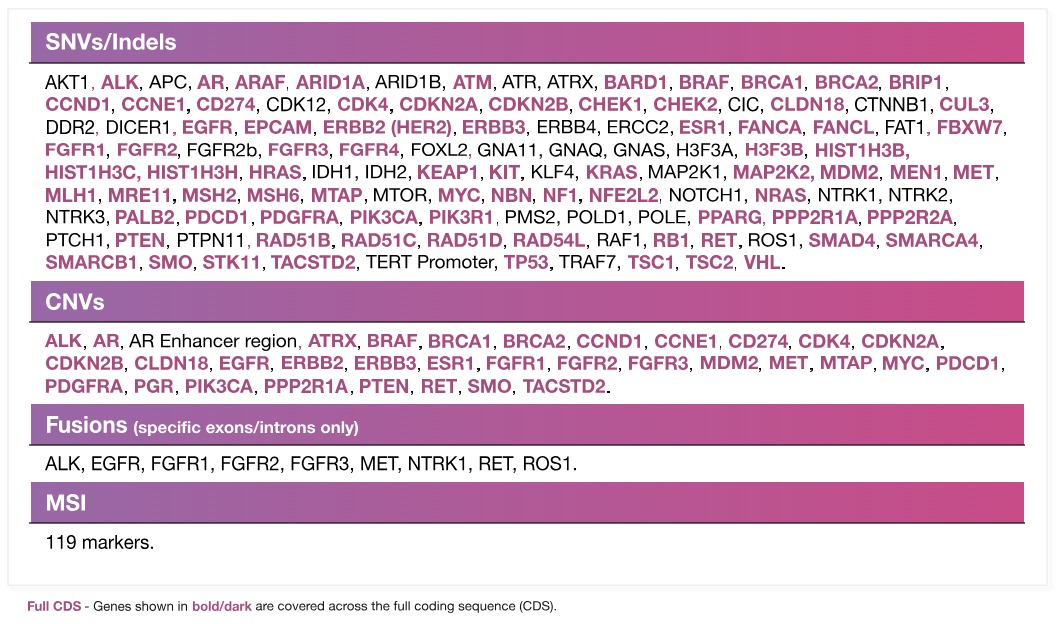
In a single test, HP1 detects SNVs, indels, CNVs and fusions. Fusions are detected directly from DNA using a patented technology. MSI is also included in the panel.
The panel covers the genes that drive treatment decisions in the most common solid tumours.
The panel covers all ESCAT Level I targets and the genes recommended in the NCCN guidelines.
The same workflow for tissue samples and for liquid biopsy.
The panel can detect gene fusions at the DNA level.
The low input requirement handles plasma (from 10 ng) as well as small biopsies (from 30 ng). Works with standard extraction kits.
Data analysis and reporting in one place, from secondary analysis to the clinical report. The final analysis takes less than five minutes.
Based on the original Hedera Dx specification. Genes shown in dark type are covered across the full coding sequence (Full CDS). MSI status is determined from 119 markers.
The entire workflow takes place in your laboratory. Hedera Dx supplies the kit, the library preparation protocol, hybrid capture and the Hedera Prime software. The output is a clinical report for the oncologist or molecular pathologist.
From FFPE tissue or plasma. Library preparation requires a minimum of 30 ng of DNA from FFPE and 10 ng of cfDNA.
Twist Bioscience technology. Uses UMI to increase the accuracy of low-frequency variant detection. Runs on standard laboratory equipment, with nothing extra to buy.
Hybrid capture of 115 genes, including fusion detection directly from DNA.
The panel runs on standard Illumina and Element Biosciences sequencers.
Complete data analysis through to the clinical report. The final analysis takes less than five minutes.
With HP1 you can use the Hedera Comply programme. It guides your laboratory through local validation and the transition to operation under IVDR. It includes on-site training for your team, technical documentation and ongoing support from Hedera Dx application specialists.
You do not have to handle validation and documentation on your own: you get a ready-made procedure that you simply follow.
We will walk you through the technical requirements, the sample specifications and how to use the Hedera Prime software. We can offer you a trial kit on favourable terms.