43 genes, 148 kb
An extended panel with 148 kb of targeted content. The workflow is the same as for HP2.
Liquid biopsy · Extended panel
Hedera Profiling 3 is the extended version of the liquid biopsy test for the most common solid tumours: lung, breast, ovarian and prostate. Compared with the compact HP2, it covers more ESCAT Level I genes (over 90%) and 148 kb of targeted content. It is suited to cases where you need a more detailed basis for treatment selection or for enrolling a patient in a clinical trial.
HP3 is the sister panel to HP2 for situations where 32 genes are not enough. Its extended content of 43 genes (148 kb) covers over 90% of ESCAT Level I targets, compared with more than 80% for HP2. The workflow from sample to report stays the same.
HP3 retains all the features of the Hedera Profiling platform: hybrid capture with UMI-based error correction, fusion detection directly from DNA without RNA sequencing, MSI status determination and the clinical report in the Hedera Prime software.
An extended panel with 148 kb of targeted content. The workflow is the same as for HP2.
Covers more than 90% of ESCAT Level I targets, useful where you need a broader basis for treatment decisions.
Point mutations, small indels, copy-number variations and MSI status in a single test.
The panel detects gene fusions directly from ctDNA. You need neither a second library nor RNA sequencing.
Molecular identifiers correct read errors. The result is higher accuracy at low variant fractions.
Minimum input 10 ng, 30 ng recommended. Collection into Streck cfDNA BCT tubes.
Based on the original Hedera Dx specification. The panel also covers METex14 skipping and the EGFR vIII variant. MSI status is determined from 36 markers.
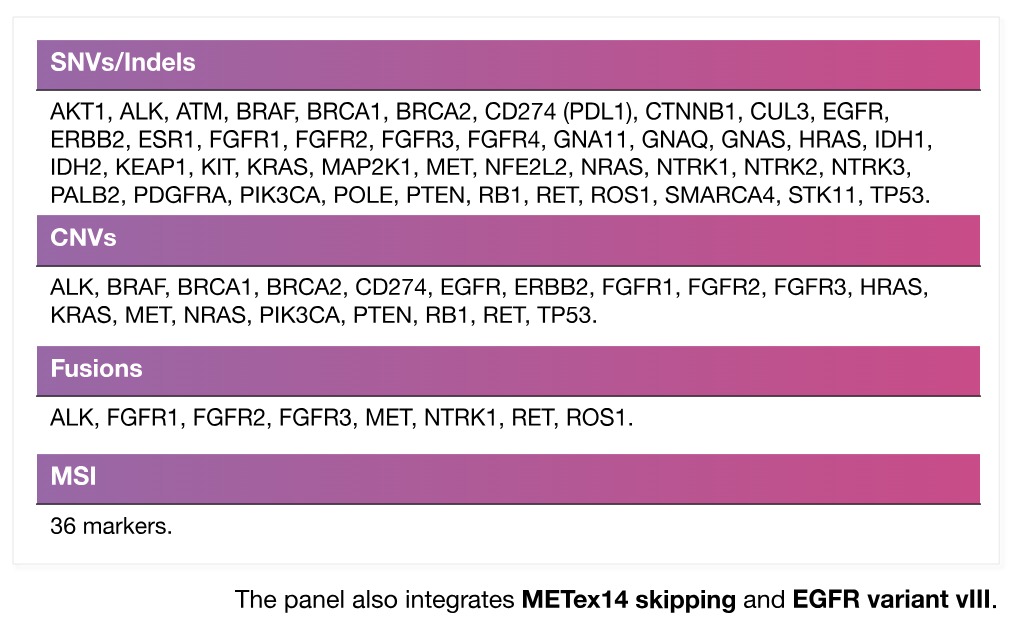
A complete profile from ctDNA: driver mutations, MET ex14, EGFR resistance variants and fusions.
ESR1 for endocrine resistance, PIK3CA and other markers for treatment selection, all from a single blood draw.
Compared with HP2, it covers more of the variants that drive targeted therapy decisions.
A molecular profile for targeted treatment of advanced disease. Also suitable for ongoing monitoring from blood.
The entire workflow takes place in your laboratory. Hedera Dx supplies the kit, the library preparation protocol, hybrid capture and the Hedera Prime software. Technician hands-on time is 3 hours, and the output is a clinical report for the oncologist or molecular pathologist.
5 ml of plasma from a Streck cfDNA BCT tube. Library preparation requires a minimum of 10 ng of cfDNA, with 30 ng recommended.
Twist Bioscience technology. Uses UMI to increase the accuracy of low-frequency variant detection. Runs on standard laboratory equipment, with nothing extra to buy.
Hybrid capture of 43 genes (148 kb), including fusion detection directly from DNA.
The panel runs on standard Illumina and Element Biosciences sequencers.
Complete data analysis through to the clinical report. The final analysis takes less than five minutes.
HP3 comes with the Hedera Comply programme. It takes your laboratory all the way from installation to operation under IVDR.
We will walk you through the technical requirements, the sample specifications and how to use the Hedera Prime software. We can offer you a trial kit on favourable terms.