1-channel
Ranges of 1–50 µl and 5–1,000 µl. For routine pipetting, master mixes and individual transfers.
Flagship robot · Focused on NGS
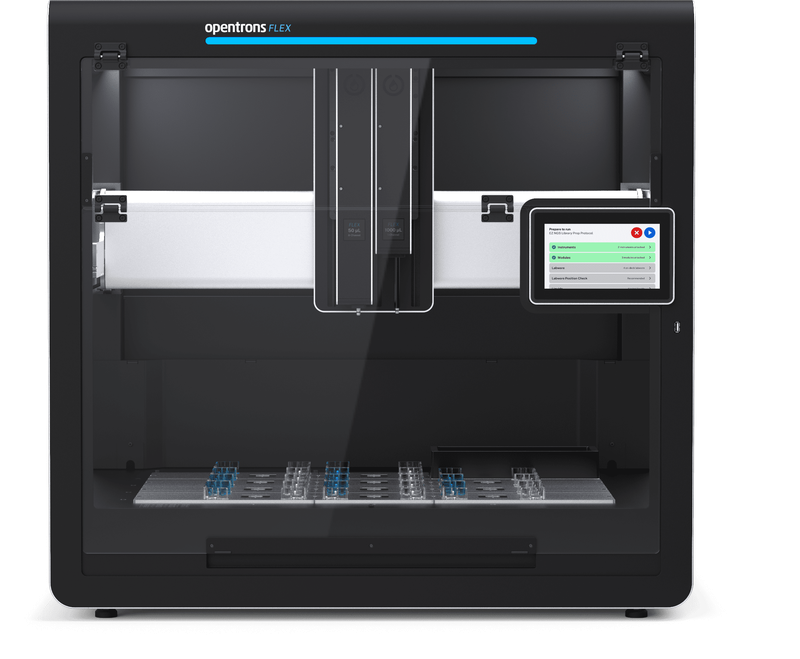
Flex is the new generation of Opentrons robots. It has a 96-channel pipette, 12 deck slots and 4 staging slots, automatic XYZ calibration, a gripper and a touchscreen display. It is designed mainly for sequencing library preparation, but its open architecture also handles PCR, extraction or protein purification.
Flex is built as an open system. The hardware is modular, the software is open, and protocols are written with the Python API or assembled in a graphical editor. You don't have to learn a proprietary language or pay a licence for every new method.
Compared with OT-2, Flex brings three advances. First, a 96-channel head that pipettes an entire plate at once. Second, automatic calibration with capacitive sensors, so pipette and tip positions are no longer set by hand. Third, a gripper that moves plates and tip racks between slots. Everything is controlled from the touchscreen on the robot itself.
Three pipette types, swapped in seconds without recalibration. Accuracy 8% and precision 7% at 1 µl.
Ranges of 1–50 µl and 5–1,000 µl. For routine pipetting, master mixes and individual transfers.
Ranges of 1–50 µl and 5–1,000 µl. For column operations on a 96-well plate, dilutions and tube-to-plate transfers.
Ranges of 1–200 µl and 5–1,000 µl. Pipettes an entire 96-well plate at once, which is key for library preparation in larger batches.
Interchangeable modules that install directly into deck slots. They are combined according to what the robot needs to do.
PCR directly on the robot deck, without moving the plate off the instrument. Handles standard PCR protocols as well as library amplification.
Heating and shaking in a single slot. For magnetic bead clean-ups, resuspension and incubations above room temperature.
Temperature control from 4 °C to 95 °C for reagents and enzymatic reactions that need a stable temperature.
A passive magnetic plate for SPRI bead clean-ups (AMPure XP, KAPA Pure Beads). Compatible with most NGS protocols.
The features that set Flex apart from older liquid-handling robots.
A mechanical gripper moves plates and tip racks between slots and modules. This lets a multi-step protocol run without operator intervention, for example moving a library from the heater-shaker to the magnetic block and back.
Capacitive sensors locate pipette and tip-rack positions on their own. Setting up a new protocol takes minutes instead of hours.
A 7" LCD screen on the robot itself, for protocol start, progress and alerts. The built-in camera lets you monitor the run and troubleshoot remotely over the network.
Flex was designed primarily for sequencing library preparation in larger batches. The 96-channel head, on-deck thermocycler, heater-shaker and magnetic block cover every step of a standard protocol: fragmentation, adapter ligation, amplification, SPRI bead clean-up and pooling.
For this purpose, Opentrons sells a pre-configured NGS Workstation that includes the robot, a complete set of modules and consumables. 3GENES supplies protocols for it that are verified for specific kits from Twist Bioscience, OncoDNA and Hedera Dx.
The 96-channel head processes an entire 96-well plate in a single step, without pipetting column by column.
The thermocycler is right on the robot, so libraries are amplified without moving the plate to another instrument. A shorter workflow and fewer opportunities for error.
The heater-shaker, magnetic block and precise pipetting handle the magnetic bead clean-up steps (AMPure XP, KAPA Pure) automatically.
The robot calculates and dilutes libraries into an equimolar pool before sequencing, with no manual recalculation and no pipetting errors.
We are the official Opentrons partner for the Czech Republic, Slovakia and Poland and also a distributor of NGS and diagnostic kits. That is why we write protocols for these kits ourselves, test them on real samples and supply them free of charge with our products.
We have ready-made scripts for several Twist Bioscience protocols and can create more on request.
Details →An automated workflow for OncoDEEP® library preparation from FFPE samples. Pipetting of hybridisation mixes, clean-up, capture and finalisation run on Flex without operator intervention.
Details →Automation of the Hedera Profiling panels (HP1 for FFPE and cfDNA, HP2 and HP3 for cfDNA) on Flex: hybrid capture, library preparation with UMIs, clean-up.
Details →
Preparing reaction mixes, pipetting master mixes, filling plates. Combined with the on-deck thermocycler, there is no need to transfer the plate to another instrument.
DNA and RNA isolation from cells, tissue and plasma with the magnetic block, heater-shaker and temperature module. Compatible with both Norgen and QIAGEN kits.

Protein purification, antibody work and plate preparation for ELISA. Either from a ready-made workstation or following your own protocol.
A graphical editor in the browser. You build a protocol from blocks, export it and run it, with no coding required. Sufficient for routine pipetting and simpler workflows.
An open library of ready-made protocols from Opentrons and its users: library preparation, extraction, PCR. Protocols can be reused, modified and shared back.
Full programmatic access for complex workflows. Multi-step protocols, dynamic branching, custom logic: everything you cannot build in the graphical editor. This is where our application specialists work.
We can advise on the configuration of pipettes and modules, help with a protocol for your method and provide servicing.